

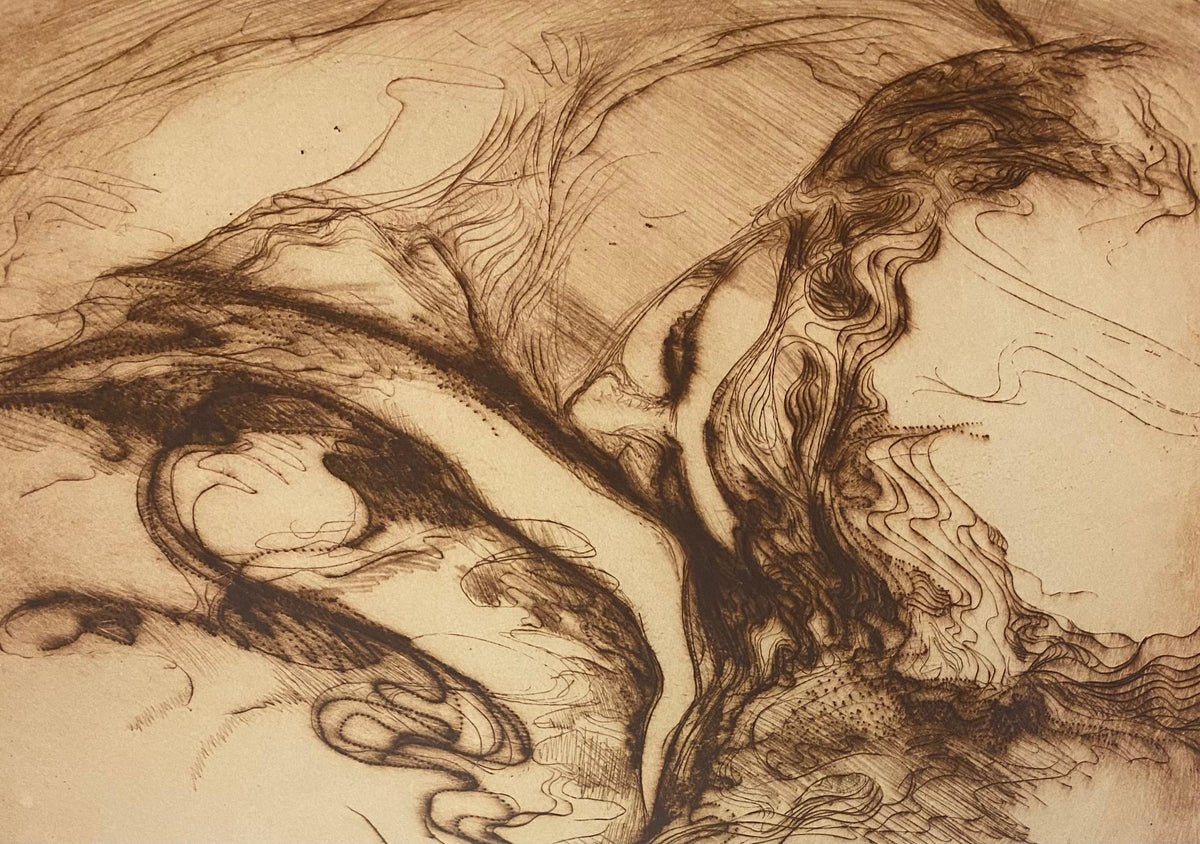
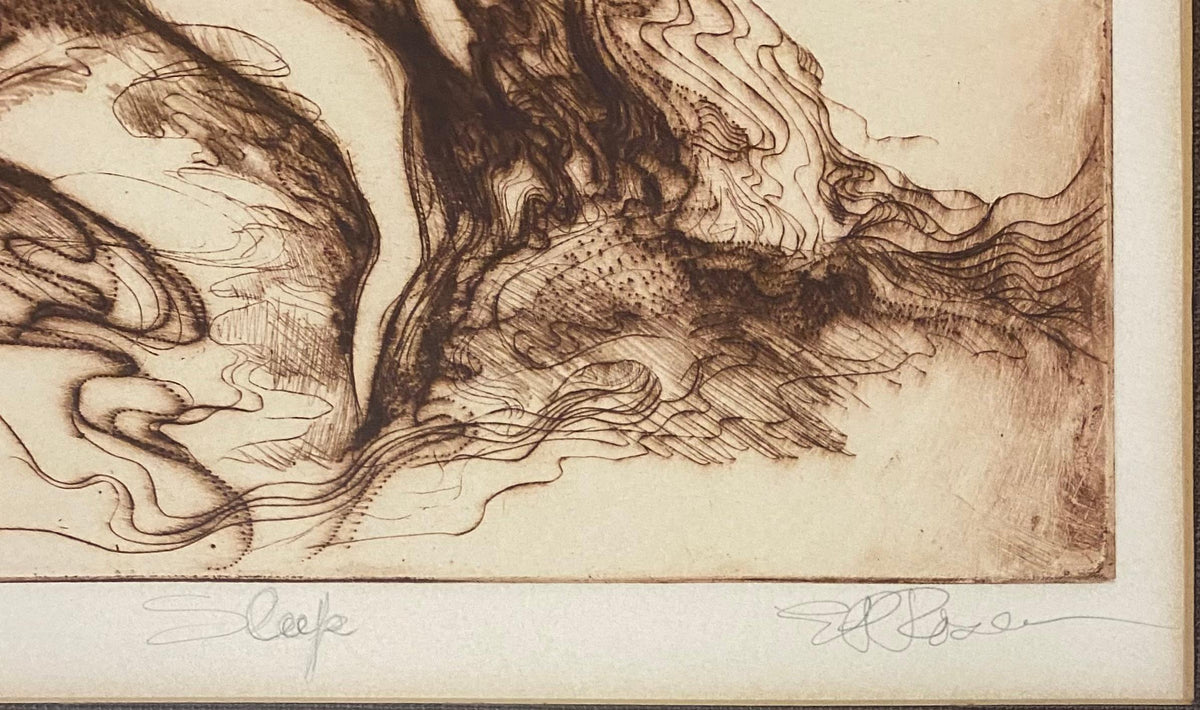

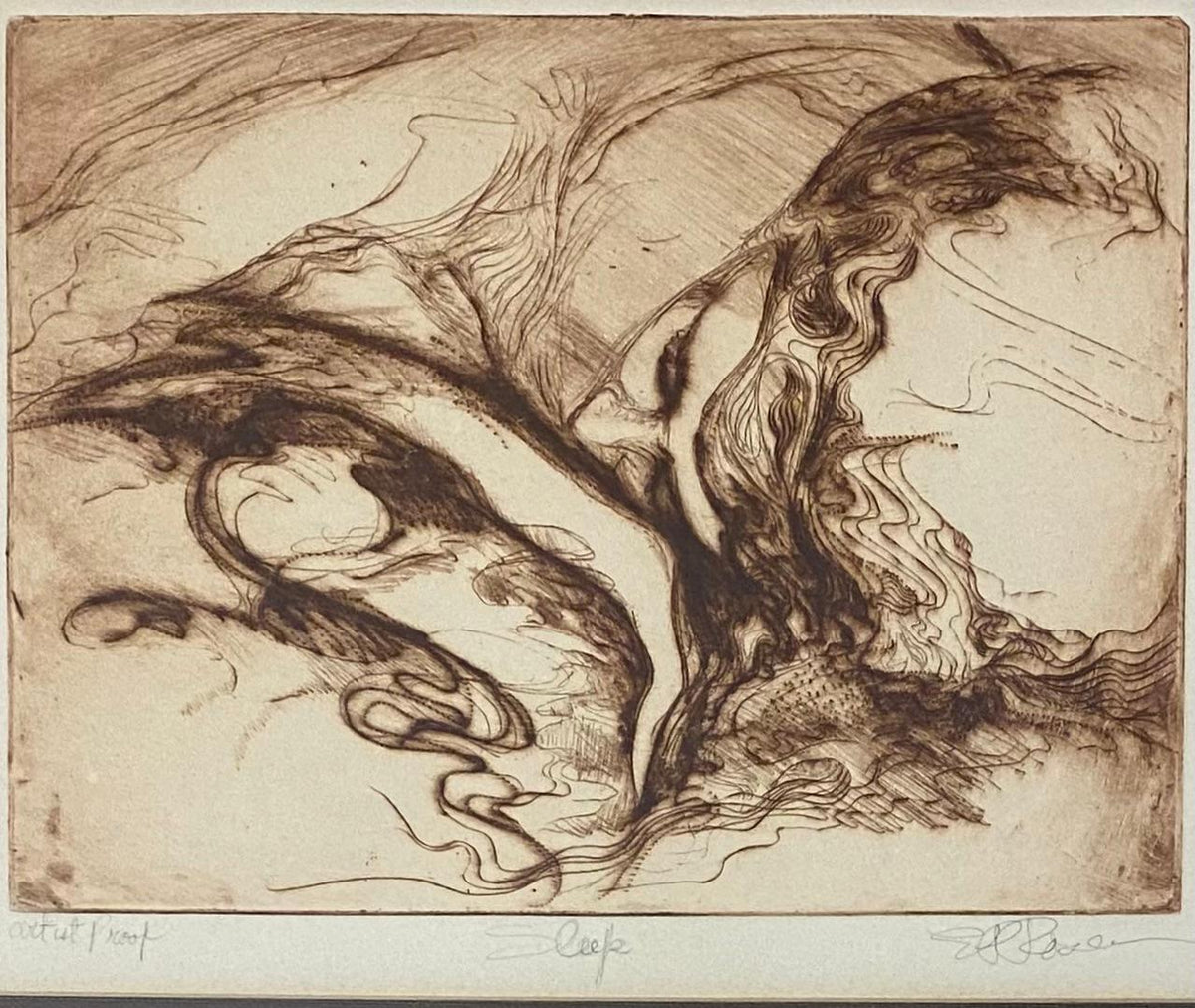
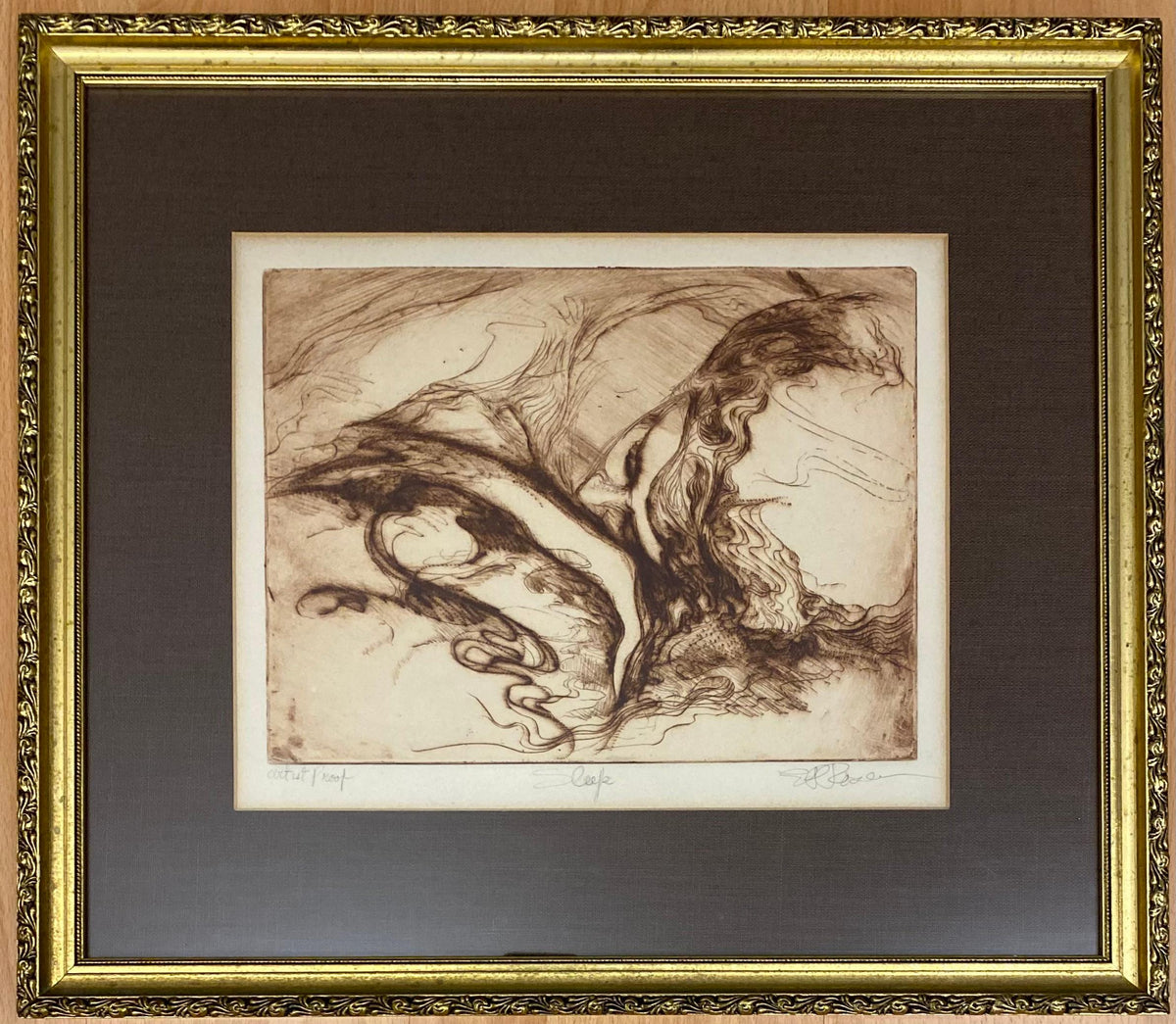
Eugene Leroy Abstract Composition, French Artist Proof Titled "Sleep"
Additional photographs, measurements or a condition report — sent the same day. Call 305-975-0601.
If it is not as we described it, we make it right. Wrong dimensions, undisclosed damage, or any material misdescription — tell us within 7 days and we refund you in full, pay the return shipping, and charge no restocking fee.
- White-glove freight, quoted per order, room of choice
- In stock in Miami — no transatlantic wait, no customs
- To the trade: 15% on everything
Professionally framed.
Eugene Leroy (1910-2000) Listed artist and represented by internationally recognized galleries.
Eugène Leroy spent most of his career in rural isolation and relative obscurity until the 1980s, when figurative painting came back into vogue and his work became increasingly recognized both in his native France and overseas.
A native of Tourcoing, France, he was a most singular artist whose work left its mark on the 20th century. Through a powerful connection to matter without ever excluding the depicted subject, Leroy always worked with traditional pictorial genres, like the nude and self-portrait, while reinventing the viewer’s perception. After remaining relatively unknown for many years, his oeuvre took on an international dimension in the 1980s after he met the art dealer and collector Michael Werner.
Through a rich ensemble of paintings, drawings, prints, sculptures and artworks from his personal collection that punctuate his evolution from 1930 to 2000, his sons made an exceptional donation to the Musee des Beaux Art in his hometown of Tourcoing. Eugene Leroy was a multifaceted and unusual artist.
Leroy labored on canvases for months, sometimes years, applying layer after layer of oil paint, brushing, scraping, and digging it and squeezing directly from the tube until the original image was barely discernible. The thick, textured physicality of his surfaces has prompted comparisons with Rembrandt, van Gogh, and Willem de Kooning, while the fragmentation of his subjects into tiny flecks of color and light recalls aspects of both Impressionism and Neo-Impressionism.
A wonderful decorative piece of art.
Professionally framed, measures: 20 3/8" W x 17 3/4" H x 1" D
Although his oeuvre has long remained under the radar, Eugène Leroy is counted among the greatest artists of the twentieth century. It was only in 1988 that his first major Parisian exhibition was held at the Musée d'Art Moderne in the ARC spaces. Spanning over sixty years, the output of this painter – who was born in Tourcoing in 1910 and died in 2000 – was equally based on the perception of the real and an ideal vision of painting.
Partial to the old masters and willingly anachronistic, Eugène Leroy revisited traditional iconographic subjects such as nudes, self-portraits, still lifes, or landscapes throughout his lifetime. More than a retrospective, the exhibition layout, organized thematically, highlights the complexity of a lengthy creative process and pictorial experimentation.
For years Eugène Leroy juggled his painting activity with a career as a Latin and Greek teacher. Since his first solo show, held in Lille in 1937, he has made his mark as an artist in a category of his own. He exhibited his canvases in Paris in 1943, then participated in several iterations of the Salon de Mai in the 1950s. He travelled often in Europe, then to the United States and Russia, where he visited museum collections, seeking to associate his painting with that of the great masters and hone the pictorial knowledge essential to his work. In 1958, he moved into a small home-studio in Wasquehal, in northern France.
The Parisian gallery Claude Bernard exhibited his work in 1961. lt was on that occasion that the German painter Georg BaseIitz and the dealer Michael Werner discovered his work. "I found in it images, as brown as fields, as stone, as wood, as mass, as scent. A simple Dutch composition with an unheard-of accumulation of colors. A heap of splattered sheet metal from a dovecote that enlightened me," wrote Baselitz.
In 1978, his eldest son opened the Jean Leroy gallery in Paris, where he regularly presented his father's work. In 1982, Jan Hoet, then director of the Museum of Contemporary Art in Gand, Belgium, whom Leroy had met during a trip to the United States, devoted a major exhibition to his work and included him in Documenta 9 in Kassel. At the same time, the establishment of a fruitful collaboration with Michael Werner allowed Eugène Leroy's oeuvre to gain European and international recognition.
As Bernard Marcadé has pointed out, "the contribution of Eugène Leroy's oeuvre to twentieth century art is decisive because it bears witness to an incessantly reiterated combat of painting and image." Beyond its thickness - but also thanks to it - this painting creates a new pictorial language that is deeply rooted in the real without any concern for its legibility.
Eugène Leroy sought to capture a truth about perception while preserving the emotion that makes it possible. "All I have ever tried to do in painting is reach [ ... ] a kind of absence almost, so that painting is totaIly itself," he stated in 1979. He reworked his canvases, sometimes over the course of several years, until the quasi-disappearance of the subject. The difficulty of discerning at first glance the painted motif allows the viewer to linger aver the physical presence of the work. His painting was " an act of memory, a projection forward across the present darkness of history," to borrow the poet Yves Bonnefoy's well-turned phrase about Rimbaud.
Partial to the old masters and willingly anachronistic, Eugène Leroy revisited traditional iconographic subjects such as nudes, self-portraits, still lifes, or landscapes throughout his lifetime. More than a retrospective, the exhibition layout, organized thematically, highlights the complexity of a lengthy creative process and pictorial experimentation.
Eugène Leroy's works are held in major public and private collections in France and abroad. With around forty paintings and drawing, acquired thanks to purchases and regular donations since 1988, the Musée d'Art Moderne de Paris is now considered a reference place for the artist.
Eugène Leroy
1910–2000, Tourcoing / Lille, France
- Born
- August 8, 1910, Tourcoing
- Died
- May 10, 2000, Lille
- Movement
- Art Informel
- Recognition
- Michael Werner Gallery solo show, 1983
Eugène Leroy was born August 8, 1910, in Tourcoing, France. He studied briefly at the École des Beaux-Arts in Lille and Paris beginning in 1931, and from 1935 settled near Roubaix, working as a teacher of Latin and Greek alongside his painting practice.
His work, associated with the Art Informel movement, focused primarily on the nude, built up through repeated layers of paint. He remained largely unrecognized until the Neo-Expressionist revival of the early 1980s, when his first major solo exhibition was held at Michael Werner Gallery in Cologne in 1983.
The name Eugène Leroy is shared by other artists; confirm any specific work against this painter's known Art Informel style and Roubaix/Lille circle before attribution.
Biographical detail from Galerie Nathalie Obadia.
Quoted per order, never estimated
Domestic freight
Every piece ships from our warehouse in Miami. Furniture travels white-glove with BMC International Freight, room of choice, subject to the carrier’s access at your address. Freight transit is typically 7–14 business days; we contact you to arrange a delivery window. Smaller pieces travel insured by ground courier.
International
We ship worldwide, quoted case by case. Tell us the piece and the destination and we will price crating, freight, insurance and customs handling for you.
Packing
Packed by hand. Fragile items are double-boxed with custom foam inserts. Glass and detachable elements are removed, packed separately and reassembled on arrival.
If something arrives damaged
Photograph the packaging and the piece before unpacking further, and contact us within 48 hours. We handle all freight claims directly and will arrange a resolution.
Returns
One day from delivery for a change of mind — buyer pays shipping and a 15% restocking fee. If the fault is ours, none of that applies: 7 days, full refund including your original shipping, we pay the return freight, no restocking fee. See our refund policy.
Request a shipping quote
We price the actual crate, the actual route, the actual service level, and send it before you commit.